The admirals and diplomats eat the most. Quality is not an issue with ghouls, but quantity is essential. The hunger is never sated, but the more you eat, the more rational you become. Those at the top, those who make the decisions are fed regularly. They are still utterly insane from the hunger, a howling which will not cease. Endless.
The captains and the Wardens - tasked with caring for the Restless - are the next step below, still retaining an edge of the feral ferocity associated with the wild Ghouls not incorporated into the Hungry Empire. To interfere with a Warden is one of the only crimes in the Empire.
The sailors do well from their flesh-piracy, although many captains allow the Ghoulish fear of water to maintain their focus rather regular feeding. The soldiers of the Empire are allowed to eat of the enemy dead as their pay, leading to a strange rhythm of minimalistic assaults lacking all strategy before organised, well-executed maneuvers as befitting a professional army.
The Restless are those driven to near catatonia by the lack of meat. Most the Empire's territory is taken up by these figures, sitting beneath the sun, shaded by their hats. Visitors have compared the effect to a field of flowers with dead, twitching stems, swaying in the wind and beaten remorselessly by the sunlight. As needed, sections of the Restless are rounded up and fed to a state suiting their new station.
A Note on Culture ~ Sir Terrence of Floyd
A most puzzling export of the Hungry Empire is their art and literature- truly stunning works produced by dead minds animated by a single force. This force taints all of their works, although many of the more skilled are able to cloak this terrible urge under layers of abstraction. Some of the more fashionable readers and nobles of the Nilfenberg Empire clamour for genuine articles of Ghoulish art and writing, something obviously restricted by the Church. Something about this all encompassing passion speaks to the living as much as the dead, although the scandalous knowledge of what must be bartered to obtain it no doubt thrills the jaded nobility.
Showing posts with label races. Show all posts
Showing posts with label races. Show all posts
Thursday, 9 July 2015

Sunday, 24 May 2015
Social Weave

The inner forest hides it, and it embraces the unique nature of the place. The members scuttle, passing messages along web-networks which act as telegrams, subtle vibrations giving a constant updates to the Weave. To an outsider, the monolithic system of these gigantic social spiders is sealed tight, impossible to penetrate.
Families will share central web-complexes like the noble houses of the aristocracy, with the young scions ranging far in their hunts. All families are connected to the Line, a length of web connecting all within the Weave's domain, used to pass messages along in the form of subtle vibrations. Hidden meanings and codes are common, as anyone could be listening in.
Most members are bound in a web unyielding as those they weave. The most common bond is child to parent - great broods of children carrying out the bidding of their mother. The females outnumber the males greatly, and the fathers are not directly involved with the children, although they decide how the Weave develops and grows.
The second bond is that of the client. Like the system of ancient Rome, a favour performed is to be paid back when owed desires it. And so most of the population is double-bound between their mother and their duties as a client. What these favours are is incomprehensible to bipeds, the alien arachnid mind operating in differing patterns.
Occasionally, an outcast of the Weave will capture a Magic User with the ability to speak tongues. The patient, alien mind of the spider will listen to the desperate promises of tutelage. These mage-spiders are terrible, their eight-legged patience perfect for arcane study. These few are welcomed back to the Weave, and have begun teaching others, a powerful favour indeed.
 |
| Spider's Spellbooks are hidden amongst the endless webs. |
Wednesday, 4 March 2015
A Hungry Empire
DSCF6681.jpg)
It is known that a plague was visited upon the multitudes,
wiping out almost all of the coastal peoples. A people with great respect for the
dead, the plague victims were honoured with burials in grand necropolises and tombs.
And then the hunger woke the dead.
The necropolises were struck open, the tombs defiled to
release more of their brethren. Not mindless, but so very, very hungry, the
ghouls finished off their erstwhile countrymen. And so life in the empire was
forgotten, and the dead looked further afield for their sustenance.
Ships of many nations sail forth from the blasted capital,
wherein lurk untold numbers of the dead citizens. Many a slaving run ends here,
dropping off unsellable slaves for the larder. For the truly jaded, a night on
the Necropolis promises an unforgettable, haunting experience.
The Mariner-Ghouls are knowledgeable, lacking the failings
of mortal sailors, but also deathly afraid of the water – for the older ones
would disintegrate if left to soak. The sail wide and commit piracy of the
flesh.
|
d8
|
Barter for Flesh-Trade
|
|
1
|
Coins of ancient mint, carried from their original burial site.
|
|
2
|
A Waiver of Consumption, granting immunity from flesh-piracy.
|
|
3
|
2 weeks employment of Ghoul Scouts, knowledge in tracking and hunting
sentient life.
|
|
4
|
Many Desert-Wines – it no longer parches their thirsts.
|
|
5
|
Cruel bone-nets, perfect for the man-hunt.
|
|
6
|
Contemporary maps of the coast. Only settlements and land-water boundaries
are marked.
|
|
7
|
Ancient maps of the coast. The landscape is described poetically.
|
|
8
|
Very generous amounts of rations of all kinds. Invariably looted.
|
Saturday, 20 September 2014
Impact of Golems
Continuing on from previous thoughts on golems-in-war. Probably worth noting a thing that could dispatch a golem is another, better one. Or two golems. Yeah, that'd do it.
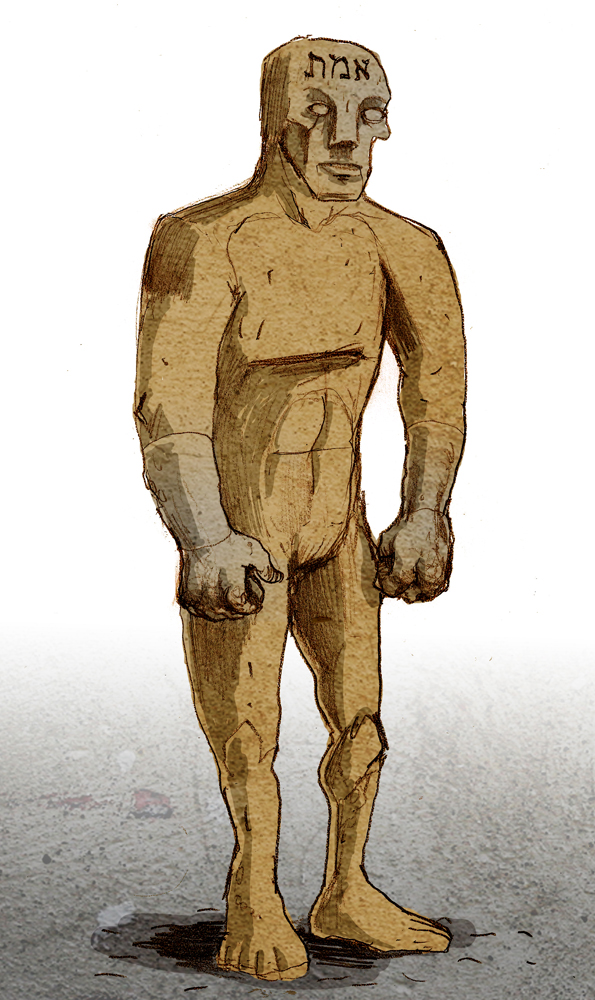
Of course, the military applications of golems is only one use. When used in industry, the widespread effect will be far more pronounced, as can be seen by the development of similar systems in actual history - the inventions of the Industrial Revolution are a good roadmap, as is the modern computerisation of many processes. A long-term investment which enables more work, faster with greater efficiency all round - no upkeep, no requirement for sleep or indeed living quarters. A well-constructed golem, though probably wildly expensive, can indeed pay for itself.
Of course, many of the negative impacts of both the industrial revolution and the modernisation of industry are inherent in golem-labour too - widespread loss of jobs for the working classes, who have been replaced. Societies using golem-labour could not simply train some of these people as operators or repairmen - as inherently magical creations, the average folk would be unable to interact with the golems in any meaningful way. This leads to widespread unemployment and dissatisfaction, a dangerous thing in a more primitive, feudal society.
Potential coping mechanisms could include the development or expansion of a permanent military force, probably equipped with arms and armour made of golem-mined ores. A well-equipped permanent army will compound the economic advantage this society has over its neighbours, and would allow significant military success - not only are the armies larger and better equipped, the men are soldiers by profession and are not needed back home to till the fields and work the mines. This is in addition to the use of golems in war, nearly assured in a society which utilizes them to the degree that a significant number of people are out of work.
In addition to this, the use of golems within industry allows for new forms of product to be created and sold - golems cannot drown, and could well be capable of extended underwater operations. Furthermore, although slow, the inherent ability to bear incredible weight and move tirelessly throughout the night makes them effective pack animals for all manner of journeys, in addition to doubling as intimidating guards.
Tuesday, 16 September 2014
Idea-Sketch for Golems
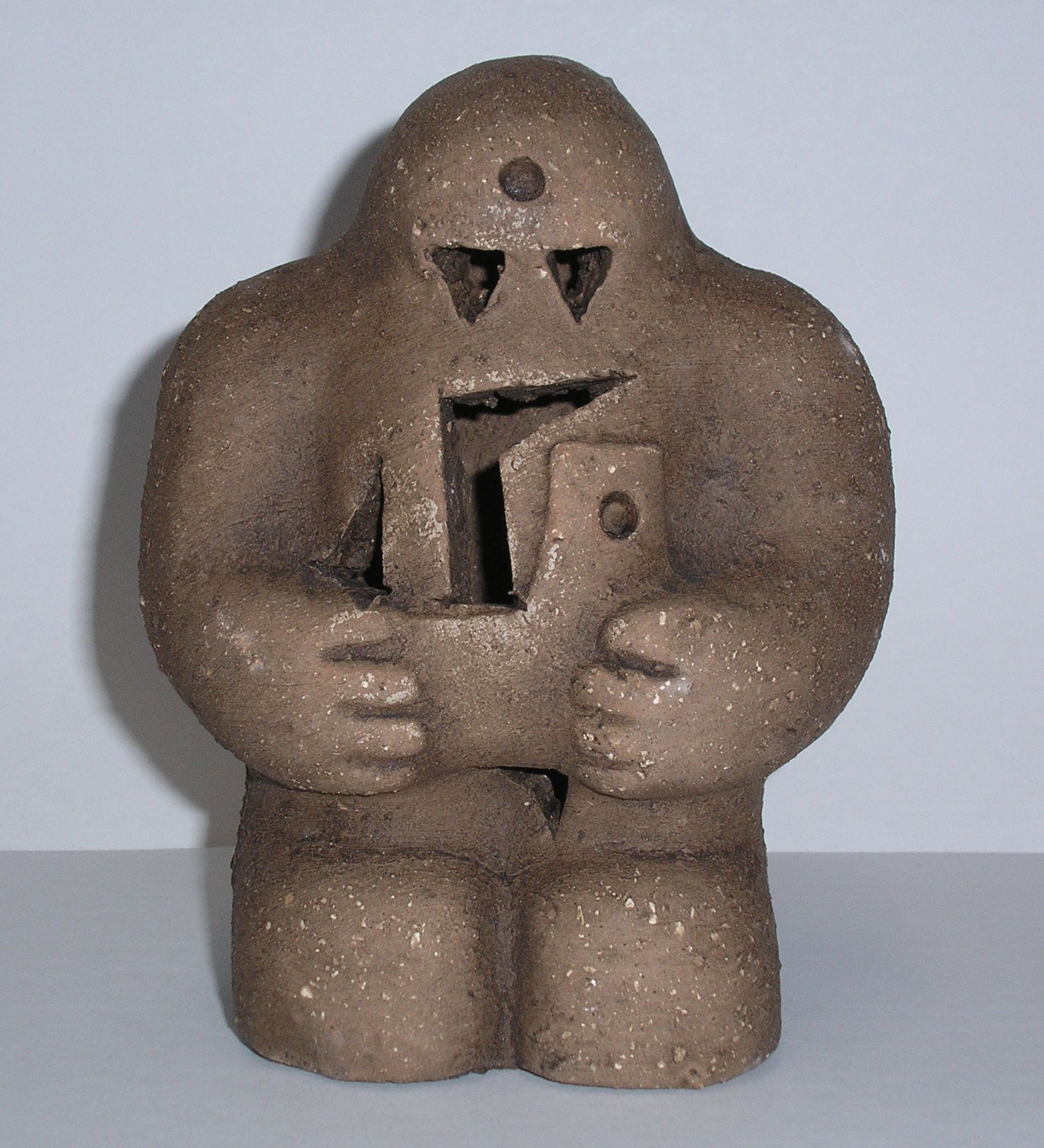
In a setting with limited magical fire-power, most monsters and creatures get ramped up significantly in terms of fear and power. A mixed blessing is the nature of many of these things - by definition, many of them are uncontrollable and therefore make for poor tools. This does not apply to a golem. Being made of construction materials, your standard weapons won't do much. Combine this with the fact they're mobile meaning scoring a hit with some form of siege weapon is pretty unlikely. As we specified at the beginning, your traditional magical artillery battery is out too. So how do you deal with such a thing?
Obviously, this depends massively on the construction materials and creation methodology, but the most common types would likely be stone and clay, with the rare iron golem appearing. Of course, there will always be more exotic and outlandish materials used for specialist application. Methods of creating golems include
- Creation via rituals, either divine or arcane
- A scroll with the name of (a) God written upon it inserted into the inert form
- Use of limited quantities of incredibly rare minerals
- Imbuing the form with a 'spark of the divine' or similar phenomena
Assuming the use of a common, workable material for the majority of the body, individuals without magical support would be forced to fight a golem using unconventional tactics. A possible strategy which could be used would revolve around three main elements - bait, trippers and sappers. A pair of horsemen would hide, a rope or chain strung between them. The bait would attract the attention of the golem, who would then approach. At this point, the riders would attempt to bind the legs of the golem using the chain/rope, causing it to trip. Thus disabled, the sapper team would then move quickly, damaging the material of the golem with appropriate tools - mining picks for stone for example. Ideally, the golem would be disabled sufficiently in a single operation, but it is not impossible that multiple trips would have to be made before the golem was rendered ineffective. Aiming for a 'mobility kill' via the legs would increase the likelihood of a single strike being effective, although a golem would have the ability to drag itself around unlike modern military vehicles which are targeted for mobility kills.
Golems created with the name of a God or with a 'brain' of rare materials could be dealt with by targeting this control element - though practically this would require an incredibly brave individual to mount to golem, survive the attempts to dislodge them whilst also removing, damaging or otherwise disabling this control element which is most likely armoured, hidden or otherwise protected. This work is far better suited to adventurers rather than the common soldier.
Given enough time, golem-traps could be constructed utilizing either deep pits or soft sand areas, in which the naturally heavy golems would become trapped and therefore unable to continue the assault.
Of course, none of this is needed with the application of either magical firepower/items or more accurate siege weapons. Fighting a golem without these things toe-to-toe is suicide, which is why the secrets of golem-crafting are not common knowledge.
Wednesday, 10 September 2014
Doppelgangers
"You does not understand the concept of an individual, but this is not to say You is not one - You simply does not empathise enough with others to understand how they are also individuals with their own helping of thoughts, fears and dreams. You does taste them however. An essential element of You's mimicry, the ability to deform and shape You's mind into an effective emulation of the target. A wolf in sheep's clothing, You will then assimilate into the life of the target, replacing them entirely to remove any suspicion before the task is carried out. You would then stay hidden until You could disappear without risking capture."
Every doppelgänger is a unique creature, more of a broad family than a member of a species. It is not known where they come from. Many struggle with issues of identity, with the most common response being to not have one - they became perfect blank slates upon which they pin their deception. Others instead fail to understand that anything else is really alive and sentient, seeing those it slips between as a great herd. Beyond these two broad archetypes, there is an infinite variety of possible outlooks and attitudes.
The 'blank slate' archetypes are owned by a handler who they are suicidally loyal to, or else aimlessly wander, replacing random individuals seemingly erratically. They often pass entirely undetected, until some unknown trigger causes a brutal slaughter, commonly met with death by the authorities.
They are known to gather in groups, most commonly when operating as mercenaries. It is not known what they do with their pay. Those who do group together are usually of the more eccentric kind, sporting more outlandish habits and preferences. They are considerably more talented, motivated and intelligent than the others of their kind, despite having no real goal. This makes them a formidable force and a great boon to those who can afford their hefty fees. Incredibly unusual is the tendency for these groups to take on names, something which exists entirely within these groups.
All members of this species have what is known as the 'rest form' - their appearance when not impersonating another. There is a great deal of variation between these, with the features approaching common usually being present on those of the 'blank slate' type ;
- Overall body is standard human configuration
- Translucent skin, not quite transparent enough for organs/bones without bright light behind them.
- No sensory organs
- No sexual organs
- Emaciated appearance
- Average height 5'5
Every doppelgänger is a unique creature, more of a broad family than a member of a species. It is not known where they come from. Many struggle with issues of identity, with the most common response being to not have one - they became perfect blank slates upon which they pin their deception. Others instead fail to understand that anything else is really alive and sentient, seeing those it slips between as a great herd. Beyond these two broad archetypes, there is an infinite variety of possible outlooks and attitudes.
The 'blank slate' archetypes are owned by a handler who they are suicidally loyal to, or else aimlessly wander, replacing random individuals seemingly erratically. They often pass entirely undetected, until some unknown trigger causes a brutal slaughter, commonly met with death by the authorities.
All members of this species have what is known as the 'rest form' - their appearance when not impersonating another. There is a great deal of variation between these, with the features approaching common usually being present on those of the 'blank slate' type ;
- Overall body is standard human configuration
- Translucent skin, not quite transparent enough for organs/bones without bright light behind them.
- No sensory organs
- No sexual organs
- Emaciated appearance
- Average height 5'5
|
D6
|
Specialisation
|
|
1
|
Theft of items with great sentimental value – this one delights in
stealing such items, and will store them in its personal stash. This stash
will be defended to the death.
|
|
2
|
Murder of the dependent – this one savours the killing of the
elderly, the children and the sickly.
|
|
3
|
Savage Brutality – it revels in pure carnage, brutally slaughtering
targets and those near – usually to have it blamed on the one being
impersonated.
|
|
4
|
Being caught – this one allows itself to be caught in the act, before
slipping away once blame is solidly levelled at the one being impersonated.
|
|
5
|
Destroying relationships – this dynamic individual will rapidly shift
to destroy all friendships and relationships the target has, leaving them
utterly alone.
|
|
6
|
Specific Impersonations – this one has a knack for impersonating a
specific variety of target, feeling incredibly comfortable in that form – to
the point that their rest form reflects this preference. Roll on table below
for the specific variety.
|
|
D6
|
Preferred Impersonation
|
|
1
|
The holy, the pious, members of clergy or of known upstanding
character.
|
|
2
|
A specific gender.
|
|
3
|
Children of a certain age – (D12 +4)
|
|
4
|
Nobility, those possessed of great wealth or titles, guild leaders.
|
|
5
|
A specific race, often from somewhere distant than their current
locale.
|
|
6
|
Those known for a specific strong temperament.
|
Friday, 29 August 2014
Burrows of the Dwarves
If one was (un)lucky enough to find an abandoned Stone Dwarf burrow, or else had conquered one by incredible military prowess, what would they find?
Entrance
A great airlock, sealed by huge reinforced discs of the hardest local stone. If there is not a suitable material available locally, huge expenditure will be made to import the very best. The tight walls of the tunnel connecting to the airlock are riddles with holes - these being placed for the militia of the poor to pelt invading Nightmares with missiles. These holes are barely enough for the weapon of choice, discouraging individuals attempting to look upon the Nightmares - this is the sole burden of the Dream Wardens. This central passage will be a veritable death-trap with several false passages. These traps are activated as the Dream Wardens advance to defend the entrance - there is no retreat for this line of defence. The militia tunnels lead directly to the slums where the Dwarven poor rub shoulders with the proud Dream Wardens. This layer is collectively known as the 'Qhywt.'
Eventually, an explorer or soldier would run into a second airlock. This would be defended by the commanders and veterans of the Dream Wardens, as a last ditch defence against invaders.
The Qhywt Proper (The Up)
The Up is an approximation of an urban sprawl in negative space - streets are wide tunnels connecting places worth going. Often lesser-used areas will only be connected by one-way passages, forcing the unfortunates to clamber atop each other. Dream Wardens, on the off chance they are in these tunnels, are always allowed to climb atop others, out of reverence for their sacrifices above and beyond the common Dwarf. Dwarves share space freely - there are simply communal dorms where those who need sleep do so. Personal wealth - what little those living in the Qhywt have - is carried about the person. Stone Dwarves do not steal from each other.
Rot Farms
The staple crops of Stone Dwarves are fungi, which are intensively farmed in the Rot Farms, huge expanses of decaying organic matter. A significant portion of this material is the Rock Dwarven dead - Stone Dwarves feel no guilt about this use of their cousins, simply viewing it as the way of things. The variety of fungi are huge, and they are simply allowed to grow where-ever they please, leading to a strange chaos of otherworldly structures nestled in the decaying mass of the dead. Rot Farm workers are incredibly respected.
Water Catchment
Burrows in porous areas filter the water trapped and filtered by the surrounding stone into huge clay bowls which are then piped around the burrow. This water is seen as a gift of the mountain. Non-porous rock areas general pump water from underground sources, though some tap into mountain streams unknowingly, thinking instead they have tapped into hidden, stony veins.
Dream Warden Barracks
Dream Wardens are completely convinced of their duties to the Stone Dwarven society, even more than the average member of the culture. When not on active duty they train near relentlessly, attempting to achieve martial perfection. The Dream Wardens are also responsible for training the crossbow militia made up of the populace of the Qhywt, and significant time is spent doing this.
The Tak (The Fall)
Behind the second airlock is a huge vertical shaft, which runs down the the Darln, the central district of the burrow. Movement between the levels is achieved via a huge cargo elevator, which moves excruciatingly slowly. Most Tak journies will take 6 hours, though this speed will vary depending on how the elevator is powered - most are muscle powered, with teams of dwarves working at the mechanism, though some advanced burrows utilize water or even steam (generated via geothermal heating) The mechanism is located nearby, in the Qhywt.
The Darln Proper (The Seat)
The Tak leads to the centre of the Darln, meaning any given area contained within this immense space is equidistant from the Tak. The entire Darln is mined out, buildings being pre-planned long ahead of time. Endless bridges and walkways connect the various stone buildings of the Darln, and ornamentation derived from the wealth of the earth is spread liberally throughout. All Dwarven industry beyond basic farming occurs here, meaning the fumes from various processes congeals and roils around at the top of the Darln, slowly bleeding out through the stone. In a significant number of older burrows, these clouds react with the condensation of living creatures to create rain showers, giving these burrows a distinctive weathered look despite being entirely sheltered from conventional weather.
At the bottom of the Darln is yet another airlock, the Kyrl (The Divide). This one puts the defences of the Qhywt to shame, with multiple metal layers and mechanisms to ensure there is no accidental opening. This is done to keep out those that lurk in the deeper dark below the burrow, oft disturbed by the miners. This area is collectively known as the Knurl.
The Knurl (The Deep)
Only the hardiest of Dwarfkind live in the Knurl - exclusively the territory of the military, who also function as miners when not performing military actions. The Sapper-Spearmen continuously dig out from the main base in the Knurl, establishing outposts and important spots. If a natural or foreign tunnel is broken into, the Delvers immediately set up a mobile head-quarters at the breech and begin scouting heavily, the base defended by a considerable cadre of Sapper-Spearmen.
The tunnels of the Dwarves are incredibly precise and uniform, marked in simple Dwarven script to make navigation easier. Their underground fortifications are truly formidable, bristling with steel and a collective memory of stubborn defiance against attackers.
Supplies and raw materials are exchanged every two weeks, utilizing the Kyrl. These exchanges are completed as rapidly as possible minimizing the risk of enemy forces getting into the Darln.
Entrance
A great airlock, sealed by huge reinforced discs of the hardest local stone. If there is not a suitable material available locally, huge expenditure will be made to import the very best. The tight walls of the tunnel connecting to the airlock are riddles with holes - these being placed for the militia of the poor to pelt invading Nightmares with missiles. These holes are barely enough for the weapon of choice, discouraging individuals attempting to look upon the Nightmares - this is the sole burden of the Dream Wardens. This central passage will be a veritable death-trap with several false passages. These traps are activated as the Dream Wardens advance to defend the entrance - there is no retreat for this line of defence. The militia tunnels lead directly to the slums where the Dwarven poor rub shoulders with the proud Dream Wardens. This layer is collectively known as the 'Qhywt.'
Eventually, an explorer or soldier would run into a second airlock. This would be defended by the commanders and veterans of the Dream Wardens, as a last ditch defence against invaders.
The Qhywt Proper (The Up)
The Up is an approximation of an urban sprawl in negative space - streets are wide tunnels connecting places worth going. Often lesser-used areas will only be connected by one-way passages, forcing the unfortunates to clamber atop each other. Dream Wardens, on the off chance they are in these tunnels, are always allowed to climb atop others, out of reverence for their sacrifices above and beyond the common Dwarf. Dwarves share space freely - there are simply communal dorms where those who need sleep do so. Personal wealth - what little those living in the Qhywt have - is carried about the person. Stone Dwarves do not steal from each other.
Rot Farms
The staple crops of Stone Dwarves are fungi, which are intensively farmed in the Rot Farms, huge expanses of decaying organic matter. A significant portion of this material is the Rock Dwarven dead - Stone Dwarves feel no guilt about this use of their cousins, simply viewing it as the way of things. The variety of fungi are huge, and they are simply allowed to grow where-ever they please, leading to a strange chaos of otherworldly structures nestled in the decaying mass of the dead. Rot Farm workers are incredibly respected.
Water Catchment
Burrows in porous areas filter the water trapped and filtered by the surrounding stone into huge clay bowls which are then piped around the burrow. This water is seen as a gift of the mountain. Non-porous rock areas general pump water from underground sources, though some tap into mountain streams unknowingly, thinking instead they have tapped into hidden, stony veins.
Dream Warden Barracks
Dream Wardens are completely convinced of their duties to the Stone Dwarven society, even more than the average member of the culture. When not on active duty they train near relentlessly, attempting to achieve martial perfection. The Dream Wardens are also responsible for training the crossbow militia made up of the populace of the Qhywt, and significant time is spent doing this.
The Tak (The Fall)
Behind the second airlock is a huge vertical shaft, which runs down the the Darln, the central district of the burrow. Movement between the levels is achieved via a huge cargo elevator, which moves excruciatingly slowly. Most Tak journies will take 6 hours, though this speed will vary depending on how the elevator is powered - most are muscle powered, with teams of dwarves working at the mechanism, though some advanced burrows utilize water or even steam (generated via geothermal heating) The mechanism is located nearby, in the Qhywt.
The Darln Proper (The Seat)
The Tak leads to the centre of the Darln, meaning any given area contained within this immense space is equidistant from the Tak. The entire Darln is mined out, buildings being pre-planned long ahead of time. Endless bridges and walkways connect the various stone buildings of the Darln, and ornamentation derived from the wealth of the earth is spread liberally throughout. All Dwarven industry beyond basic farming occurs here, meaning the fumes from various processes congeals and roils around at the top of the Darln, slowly bleeding out through the stone. In a significant number of older burrows, these clouds react with the condensation of living creatures to create rain showers, giving these burrows a distinctive weathered look despite being entirely sheltered from conventional weather.
At the bottom of the Darln is yet another airlock, the Kyrl (The Divide). This one puts the defences of the Qhywt to shame, with multiple metal layers and mechanisms to ensure there is no accidental opening. This is done to keep out those that lurk in the deeper dark below the burrow, oft disturbed by the miners. This area is collectively known as the Knurl.
The Knurl (The Deep)
Only the hardiest of Dwarfkind live in the Knurl - exclusively the territory of the military, who also function as miners when not performing military actions. The Sapper-Spearmen continuously dig out from the main base in the Knurl, establishing outposts and important spots. If a natural or foreign tunnel is broken into, the Delvers immediately set up a mobile head-quarters at the breech and begin scouting heavily, the base defended by a considerable cadre of Sapper-Spearmen.
The tunnels of the Dwarves are incredibly precise and uniform, marked in simple Dwarven script to make navigation easier. Their underground fortifications are truly formidable, bristling with steel and a collective memory of stubborn defiance against attackers.
Supplies and raw materials are exchanged every two weeks, utilizing the Kyrl. These exchanges are completed as rapidly as possible minimizing the risk of enemy forces getting into the Darln.
Monday, 28 July 2014
Dwarves part 2
It would seem I have Dwarves on the brain now. More info on the Rock and Stone Dwarves.
**Semi-Spoilers for LotFP players in my campaign, could well never come up**
Rock Dwarves are given to drinking and brawling when they are surrounded by their own kind, but when non-dwarves are present they seem incredibly serious. They just can't get their drink on with strangers around.
By contrast, Stone Dwarves are serious, grim and humourless. Their lives are given up to the collective good of the Burrow, and are occupied with work for the vast majority. Despite this, there is still wealth in their lives, but Stone Dwarven economics is nigh incomprehensible to anyone but a Stone Dwarf.
In terms of agriculture, Rock dwarves are very similar to hill-dwelling humans whereas the Stone Dwarves have to adapt for their subterranean existence. A principle crop is mushrooms, which are often grown on compost made from the dead - including Rock Dwarven dead. For more variety, they trade worked stone and metal goods to their Rock Dwarven cousins. For every Burrow there are roughly 3-4 Rock Dwarf villages.
Rock Dwarves have a requirement for every member of age within the village to be trained in organised combat, the most common weapons being heavy crossbows (imported) and using a shield and spear when distances close. They fight incredibly defensively, owing to their slowed movement due to their short stature, forming a solid wedge of Dwarf, reminiscent of a Hoplite Phalanx. Individual Dwarven fighters, whilst rarer than the human equivalent, are just as likely to use any given weapon.
Stone Dwarven military endeavours are far more involved and complex. The Dream Wardens generally fight with pole-arms, though they mimic the Dwarven Phalanx formation. They use extensive use of traps and hidden tunnels to fall back and ambush invading Nightmares. The Dream Wardens do not have an organised missile element, instead using a militia of those who live close to the dream armed with crossbows and utilizing murder-holes. The lower reaches of the Burrows are guarded by two main elements - a strictly defensive force of cross-trained Sapper-Spearmen, who block up tunnels with their formations whilst others collapse tunnels on the invaders. The final, offensive element of the Dwarven military are the incredibly highly trained Delvers.
Roughly equivalent to special forces in today's forces, they are extensively trained in individual combat, fighting in smaller groups, survival in the caverns and tunnels, stealth, ambushing and scouting. They are mostly used to disrupt enemies forces whilst the slower Sapper-Spearmen move to set up favourable defensive lines. Delvers are either actively scouting below the Burrow or re-equipping. They Delve until they are eventually killed. They generally operate in sevens, but this is not a hard rule, the number being tweaked as needed. Delvers are equipped with whatever the job requires, though many of them choose to specialise in particular weapons. Spears are very rare amongst the Delvers, though light crossbows are ubiquitous.
Rock Dwarves give praise to gods of merriment and partying, and give the bodies of their dead to the Stone Dwarves for what they believe to be proper burial. (see agriculture section) Their culture suffers from some serious guilt about not being as Dwarven as the Stone Dwarves, but also poking fun at their seriousness with all the partying they do.
Stone Dwarven religion is as complex and confusing as their underground tunnels, within a complex network of deities, spirits and ancestors all balancing and counteracting each other. Worship is an incredibly private affair - asking a fellow Stone Dwarf about his religious practices is enough to be exiled. Burial is to be Given Back to the Stone - a tiny stone cell is cut out, the body is interred and then the cell is sealed. No possessions are stored bar the simple black robe of Stone Dwarven society.
**Semi-Spoilers for LotFP players in my campaign, could well never come up**
Rock Dwarves are given to drinking and brawling when they are surrounded by their own kind, but when non-dwarves are present they seem incredibly serious. They just can't get their drink on with strangers around.
By contrast, Stone Dwarves are serious, grim and humourless. Their lives are given up to the collective good of the Burrow, and are occupied with work for the vast majority. Despite this, there is still wealth in their lives, but Stone Dwarven economics is nigh incomprehensible to anyone but a Stone Dwarf.
In terms of agriculture, Rock dwarves are very similar to hill-dwelling humans whereas the Stone Dwarves have to adapt for their subterranean existence. A principle crop is mushrooms, which are often grown on compost made from the dead - including Rock Dwarven dead. For more variety, they trade worked stone and metal goods to their Rock Dwarven cousins. For every Burrow there are roughly 3-4 Rock Dwarf villages.
Rock Dwarves have a requirement for every member of age within the village to be trained in organised combat, the most common weapons being heavy crossbows (imported) and using a shield and spear when distances close. They fight incredibly defensively, owing to their slowed movement due to their short stature, forming a solid wedge of Dwarf, reminiscent of a Hoplite Phalanx. Individual Dwarven fighters, whilst rarer than the human equivalent, are just as likely to use any given weapon.
Stone Dwarven military endeavours are far more involved and complex. The Dream Wardens generally fight with pole-arms, though they mimic the Dwarven Phalanx formation. They use extensive use of traps and hidden tunnels to fall back and ambush invading Nightmares. The Dream Wardens do not have an organised missile element, instead using a militia of those who live close to the dream armed with crossbows and utilizing murder-holes. The lower reaches of the Burrows are guarded by two main elements - a strictly defensive force of cross-trained Sapper-Spearmen, who block up tunnels with their formations whilst others collapse tunnels on the invaders. The final, offensive element of the Dwarven military are the incredibly highly trained Delvers.
Roughly equivalent to special forces in today's forces, they are extensively trained in individual combat, fighting in smaller groups, survival in the caverns and tunnels, stealth, ambushing and scouting. They are mostly used to disrupt enemies forces whilst the slower Sapper-Spearmen move to set up favourable defensive lines. Delvers are either actively scouting below the Burrow or re-equipping. They Delve until they are eventually killed. They generally operate in sevens, but this is not a hard rule, the number being tweaked as needed. Delvers are equipped with whatever the job requires, though many of them choose to specialise in particular weapons. Spears are very rare amongst the Delvers, though light crossbows are ubiquitous.
Rock Dwarves give praise to gods of merriment and partying, and give the bodies of their dead to the Stone Dwarves for what they believe to be proper burial. (see agriculture section) Their culture suffers from some serious guilt about not being as Dwarven as the Stone Dwarves, but also poking fun at their seriousness with all the partying they do.
Stone Dwarven religion is as complex and confusing as their underground tunnels, within a complex network of deities, spirits and ancestors all balancing and counteracting each other. Worship is an incredibly private affair - asking a fellow Stone Dwarf about his religious practices is enough to be exiled. Burial is to be Given Back to the Stone - a tiny stone cell is cut out, the body is interred and then the cell is sealed. No possessions are stored bar the simple black robe of Stone Dwarven society.
Sunday, 27 July 2014
Developing some details for the LotFP game
Just some rough 'sketches' of stuff for my LotFP campaign. Probably boring and derivative.
Elves.
The forests are rich, old and dark. The beasts roam free and those not welcome in the communities lurk and brood. The roads are dangerous and thin when they do exists, and only skirt the light outer edges. The deep forests were not meant for man. The inner, ancient woodland is haunted by a race inimical to man. They flit between the trees and plants, passing freely through the densest foliage and most difficult terrain. They trap, confuse, cut, shoot and bleed intruders. Your body will be left for the animals, decomposing to feed nutrients to the plants. They are the Elves.
Once their dominion projected forth from the forests. Your grandfather's grandfather may remember the time of the Illyan - a time where a cousin of the Elves of today held the area in a tight grip, and man was nought but a plaything. The ruins of this time are scattered about the land, invariably containing valuables, secrets and death. We do not know why they retreated, only that they did. And now Elves are only spoken of in hushed whispers matched with furtive glances at the oh-so-brave adventurers asking about them. No good can come of disturbing their land.
Dwarves.
There are two kinds of Dwarf - the dour Rock and the unseen Stone. Rock dwarves live in hill communities, farming pastorally much as men would in similar places. However, they have fantastic metal and stone work at their disposal thanks to trade with the Stone. Rock dwarves are unwelcoming of humans, and barely tolerate visitors for any length of time, especially adventurers.
We know nothing about the Stone Dwarves bar that they spend their entire lives underground.
--DM INFO--
The Stone Dwarves do not believe in the surface. It is merely a dream in the minds of the those who truly exist. Those Dwarves who dwell there are the Dreamers, or the Sleeping. They are fools of great use, for they and they alone can evoke things from the Dream into the reality of Down. Though only the better-off Dwarves can afford such delicacies, the Dreamers do well of the trade. They do not attempt to understand, for the nature of reality does not suit them - they find it distasteful after the Dream.
Sometimes Nightmares pierce their way into the real, through holes the Sleepers insist of leaving open, or perhaps through their own ken. The Sleep Wardens guard such places, and are uniquely gifted in comprehending both the reality and the Dream. They can never experience the true reality because of this, and are confined to the upper layers of the real, where the borders are thin. The real is dark and stretches on beyond ken, but it is finite. The Dream is infinite and filled with unreliable, fickle lights and beings.
Elves.
The forests are rich, old and dark. The beasts roam free and those not welcome in the communities lurk and brood. The roads are dangerous and thin when they do exists, and only skirt the light outer edges. The deep forests were not meant for man. The inner, ancient woodland is haunted by a race inimical to man. They flit between the trees and plants, passing freely through the densest foliage and most difficult terrain. They trap, confuse, cut, shoot and bleed intruders. Your body will be left for the animals, decomposing to feed nutrients to the plants. They are the Elves.
Once their dominion projected forth from the forests. Your grandfather's grandfather may remember the time of the Illyan - a time where a cousin of the Elves of today held the area in a tight grip, and man was nought but a plaything. The ruins of this time are scattered about the land, invariably containing valuables, secrets and death. We do not know why they retreated, only that they did. And now Elves are only spoken of in hushed whispers matched with furtive glances at the oh-so-brave adventurers asking about them. No good can come of disturbing their land.
Dwarves.
There are two kinds of Dwarf - the dour Rock and the unseen Stone. Rock dwarves live in hill communities, farming pastorally much as men would in similar places. However, they have fantastic metal and stone work at their disposal thanks to trade with the Stone. Rock dwarves are unwelcoming of humans, and barely tolerate visitors for any length of time, especially adventurers.
We know nothing about the Stone Dwarves bar that they spend their entire lives underground.
--DM INFO--
The Stone Dwarves do not believe in the surface. It is merely a dream in the minds of the those who truly exist. Those Dwarves who dwell there are the Dreamers, or the Sleeping. They are fools of great use, for they and they alone can evoke things from the Dream into the reality of Down. Though only the better-off Dwarves can afford such delicacies, the Dreamers do well of the trade. They do not attempt to understand, for the nature of reality does not suit them - they find it distasteful after the Dream.
Sometimes Nightmares pierce their way into the real, through holes the Sleepers insist of leaving open, or perhaps through their own ken. The Sleep Wardens guard such places, and are uniquely gifted in comprehending both the reality and the Dream. They can never experience the true reality because of this, and are confined to the upper layers of the real, where the borders are thin. The real is dark and stretches on beyond ken, but it is finite. The Dream is infinite and filled with unreliable, fickle lights and beings.
Monday, 21 July 2014
Alternate Race Generation
So, I’ve been thinking about how races work through the
various editions, and I came to the realisation I much prefer having race/class
as a combination rather than being the same thing mechanically.
On top of this, I also felt that flat bonuses to stats were
kinda boring and deterministic, so instead I made a system whereby you just
have a different spread of values for your stats, generated by rolling dice
other than 3d6. So, substitute the usual stat bonuses for the rolls below. Other
abilities for races should probably be left as – is. The only issue is how to
make humans operate on-par with the demihumans – possibly give them the ability
to switch two stats? (Assuming hard rolling down-the-line)
This table should work for any system of D&D, and could
be tweaked to other systems.
|
Statistic
|
Human
|
Elf
|
Dwarf
|
Halfling
|
Orc
|
|
Charisma
|
3d6
|
2d6 + 1d8
|
2d6 + 1d4
|
3d6
|
1d6 + 2d4
|
|
Constitution
|
3d6
|
3d4
|
1d6 + 2d8
|
2d6 + 1d4
|
1d6 + 2d8
|
|
Dexterity
|
3d6
|
1d6 + 2d8
|
1d6 + 2d4
|
3d8
|
3d6
|
|
Intelligence
|
3d6
|
3d6
|
3d6
|
3d6
|
1d6 + 2d4
|
|
Strength
|
3d6
|
3d6
|
2d6 + 1d8
|
1d6 + 2d4
|
3d8
|
|
Wisdom
|
3d6
|
3d6
|
3d6
|
3d6
|
3d6
|
The above rolls use human as a baseline, Elves as graceful,
charming but fragile, Dwarves as strong, tough but dour and clumsy, Halflings
as nimble yet weak and fragile and Orcs as powerful physically but stunted in
other areas.
So, using the above table, we get the following spread of
statistics amongst the average
members of that race.
|
Statistic
|
Human
|
Elf
|
Dwarf
|
Halfling
|
Orc
|
|
Charisma
|
7-12
|
9-15
|
7-11
|
7-12
|
7-11
|
|
Constitution
|
7-12
|
5-9
|
8-16
|
7-11
|
8-16
|
|
Dexterity
|
7-12
|
8-16
|
6-10
|
9-17
|
7-12
|
|
Intelligence
|
7-12
|
7-12
|
7-12
|
7-12
|
6-10
|
|
Strength
|
7-12
|
7-12
|
9-15
|
6-10
|
9-17
|
|
Wisdom
|
7-12
|
7-12
|
7-12
|
7-12
|
7-12
|
Whereas this table shows the maximum possible rolled stat for any of these races, with a minimum
of 3 for any of them.
|
Statistic
|
Human
|
Elf
|
Dwarf
|
Halfling
|
Orc
|
|
Charisma
|
18
|
20
|
16
|
18
|
14
|
|
Constitution
|
18
|
12
|
22
|
16
|
22
|
|
Dexterity
|
18
|
22
|
14
|
24
|
18
|
|
Intelligence
|
18
|
18
|
18
|
18
|
14
|
|
Strength
|
18
|
18
|
20
|
14
|
24
|
|
Wisdom
|
18
|
18
|
18
|
18
|
18
|
Subscribe to:
Posts (Atom)